 ×
×
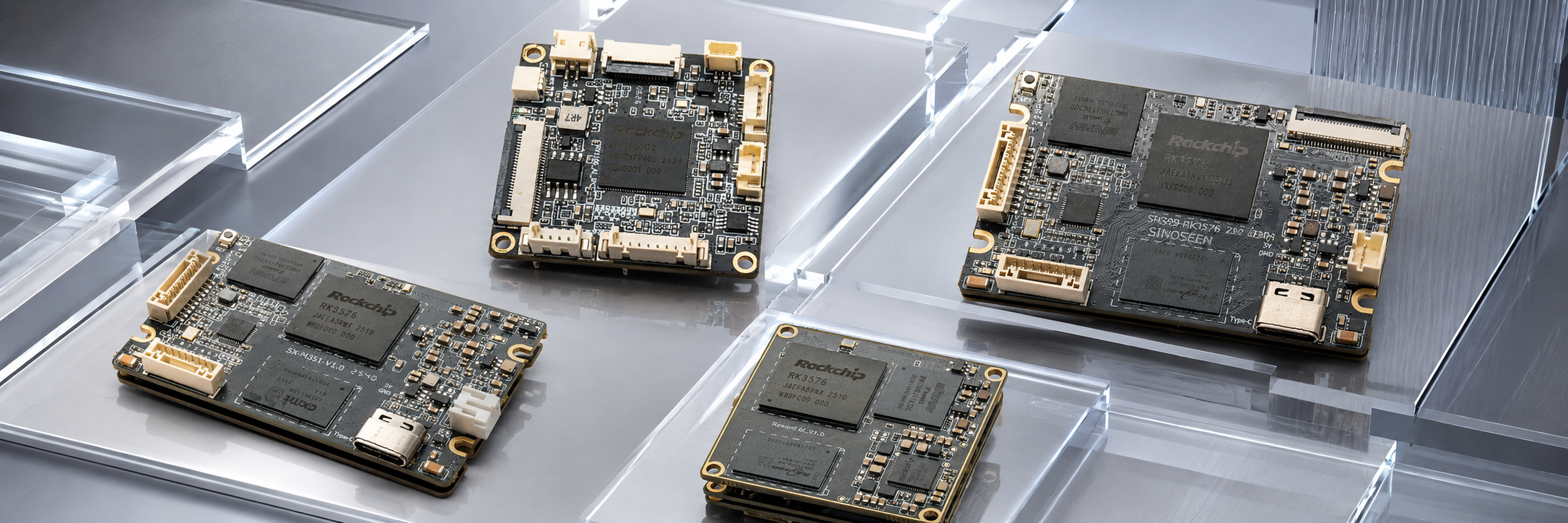
Transmitting high-quality, high-bandwidth image data has always been crucial for vision system design. This is particularly true in areas like autonomous driving, industrial automation, and robotics, where long-distance, low-latency, and highly reliable data transmission is crucial. GMSL2 cameras and Ethernet cameras are two mainstream technology solutions. Each has its own technical advantages and applicable scenarios, but also presents its own challenges.
As a consultant specializing in camera modules, this article will provide an in-depth analysis of the principles, architecture, and performance differences between these two high-speed transmission technologies: GMSL2 and Ethernet. From an engineer's perspective, we will explore the pros and cons of GMSL2 vs. Ethernet and provide a practical selection guide to help you make the most informed decision for your embedded vision application.
GMSL2 (Gigabit Multimedia Serial Link 2) is a serial communication protocol developed by Maxim Integrated (now Analog Devices). It is designed for high-bandwidth, low-latency video and control data transmission in automotive and industrial applications. A GMSL2 camera module typically consists of a CMOS image sensor and a GMSL2 serializer chip. This serializer packages and transmits MIPI CSI-2 data streams from sensors at high speed.
The core of GMSL2 lies in its efficient architecture. It can simultaneously transmit high-speed image data, bidirectional control commands, and power over a single coaxial cable or shielded twisted pair (STP) cable. This "single-cable" integration significantly simplifies wiring harness design, reducing cabling cost and complexity. This is a significant advantage for autonomous driving and ADAS systems, which are space-constrained and sensitive to cable weight.
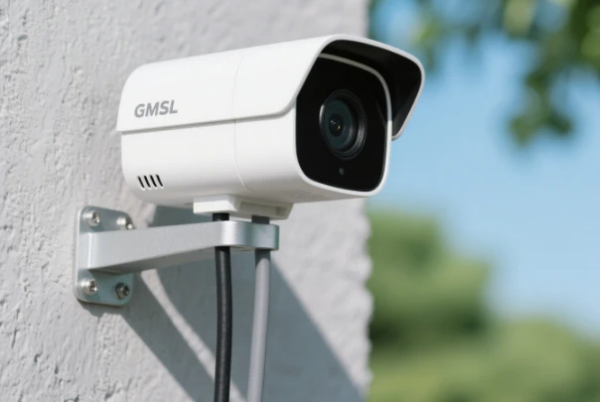
An Ethernet camera uses the Ethernet protocol to transmit image data. It leverages familiar network technologies to package image data into standard IP packets and send them over Ethernet cables. An Ethernet camera module typically includes an image sensor, an image signal processor (ISP), and an SoC or FPGA that encapsulates the video stream into Ethernet packets.
The advantages of Ethernet lie in its versatility and broad ecosystem. It allows cameras to integrate into existing standard network infrastructures and communicate seamlessly with other network devices. Furthermore, Ethernet for industrial vision is highly mature, supporting industry-standard protocols such as GigE Vision, making camera integration and interoperability simple.
Ethernet cables are the foundation of Ethernet camera connectivity. They consist of multiple twisted pairs of wires used to transmit data between network devices. Ethernet cables come in various types, such as Cat5e, Cat6, and Cat7, depending on the data rate and cable shielding structure.
Cat5e supports Gigabit Ethernet, Cat6 supports speeds up to 10Gbps, and Cat7 offers even higher performance. In machine vision and industrial applications, shielded STP (Shielded Twisted Pair) cables are often used to resist electromagnetic interference.
| Category | Transmission Speed (Max) | Distance of Transmission | Shielding Type | Bandwidth (Max) |
| Cat 5e | 1Gbps | 100 meters | Unshielded | 100MHz |
| Cat 6 | 1Gbps | 100 meters | Shielded/Unshielded | 250MHz |
| 10Gbps | 55 meters | |||
| Cat 6a | 10Gbps | 55 meters | Shielded | 500MHz |
| Cat 7 | 100Gbps | 15 meters | Shielded | 600MHz |
| Cat 7a | 100Gbps | 15 meters | Shielded | 1,000MHz |
| Cat 8 | 40Gbps | 30 meters | Shielded | 2,000MHz |
In the embedded vision field, choosing between GMSL2 and Ethernet requires an in-depth comparison based on several core technical specifications.
The following is a detailed performance comparison of GMSL2 vs. Ethernet:
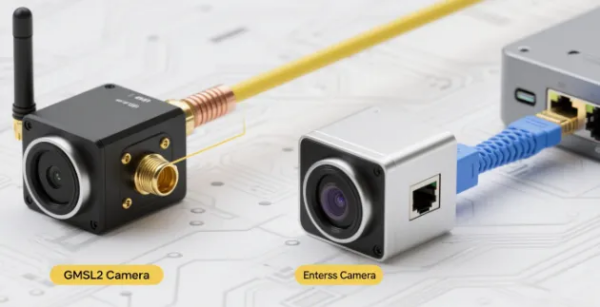
GMSL2's architecture is built around point-to-point connections. A GMSL2 camera module must connect directly to the host control system via a serializer and deserializer, limiting system scalability. This direct connection ensures extremely low latency and high reliability. This architecture is ideal for surround view systems in autonomous driving, where each camera has a dedicated data link.
In contrast, Ethernet for industrial vision uses a networked multi-point architecture. Multiple cameras can connect to the same host control system via an Ethernet switch. This architecture's selling point is its flexibility and scalability. Engineers can easily add or remove cameras and leverage existing network infrastructure. However, its drawback is that data collisions and latency uncertainty increase as the number of devices in the network increases.
In embedded vision projects, choosing between GMSL2 and Ethernet is a decision that engineers must weigh based on their specific application scenarios. Here are some practical selection guidelines:
GMSL2 cameras and Ethernet cameras, two high-speed transmission technologies, each hold a significant position in the embedded vision field. GMSL2, with its low latency, high reliability, and simple cabling solutions, is an ideal choice for autonomous driving and ADAS. Ethernet, on the other hand, stands out in the industrial and general machine vision fields thanks to its versatility, scalability, and mature ecosystem.
If you are looking for help in integrating cameras into your products, please write to us.
 Hot News
2026-09-21
2026-09-18
2026-09-14
2026-09-13
2026-09-09
2026-09-09

 EN
EN